
Nanoscale functional materials and devices for biomedical applications

Our mission is to develop the next generation of materials, tools and methods for biomedicine using core engineering sciences. Our approach is highly multidisciplinary bringing expertise from material and process engineering to health sciences. This allows for the design and engineering of biomaterials that exhibit the desired functionality in applications ranging from diagnostics to therapeutic interventions.

We focus on scalable flame aerosol manufacturing (using a flame spray pyrolysis reactor, shown right) of smart nanoscale materials and devices and tune their properties, targeting superior performance in theranostics.
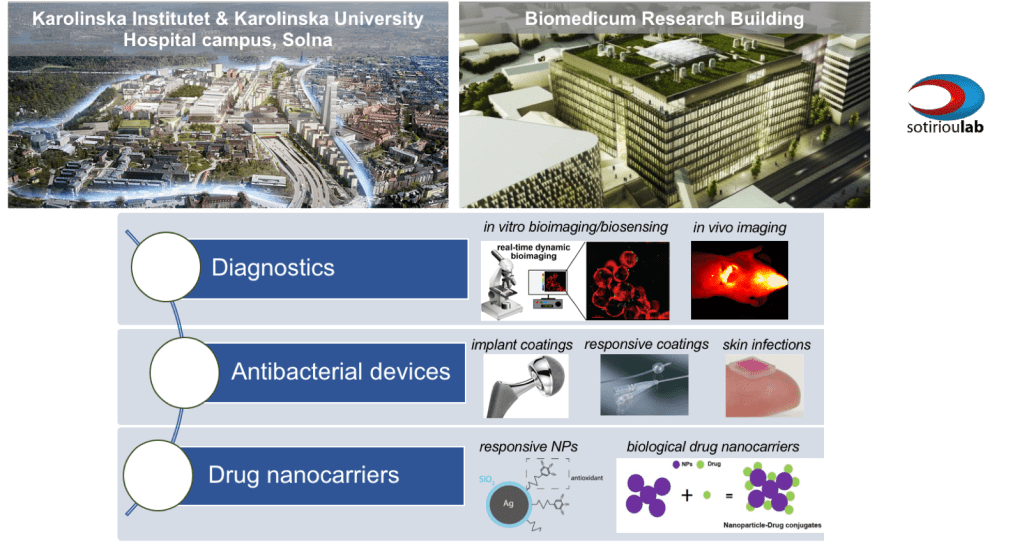
The focus of our research program at KI lies on studying the physicochemical properties of nanomaterials made by aerosol processes and then applying this fundamental understanding to tailor functional particles and particle-enabled devices for diagnosis and precision therapies of diseases. The three main research pillars of our lab regard the (i) nanoparticle engineering for in vitro and in vivo diagnostics, (ii) the fabrication of medical devices capitalizing on aerosol nanoparticle self-assembly on surfaces combining particle synthesis and particle film fabrication in a single-step, and (iii) the utilization of nanoparticles as drug nanocarriers.
NanoBiomaterials for therapeutics
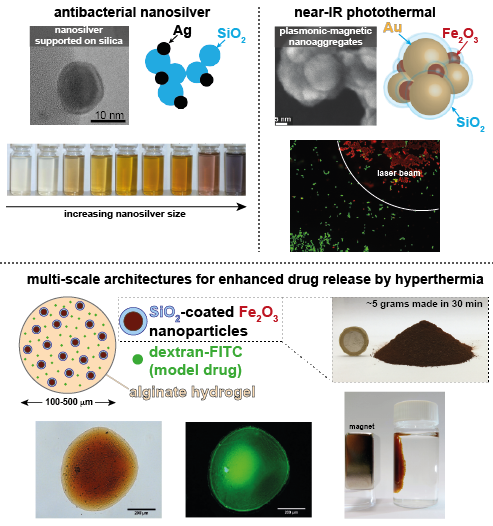
We produce nanoscale materials and employ them either as standalone therapeutic compounds, or as functional components in multiscale architectures. Specific focus areas are (i) antimicrobial nanoparticles and (ii) stimuli-responsive nanoparticles (plasmonic, superparamagnetic) aiming their integration in smart medical devices.
Novel diagnostic tools and devices
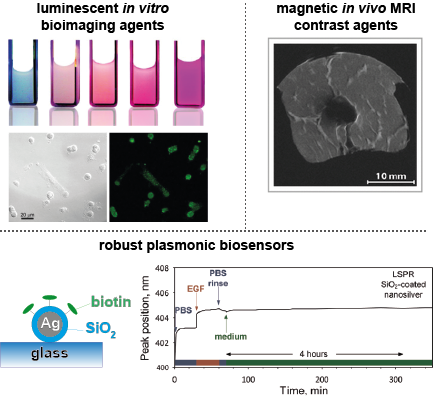
Here we focus on the fabrication of responsive materials that can be employed in diagnosis either as biosensors (e.g. for specific analyte detection), or as bioimaging agents (e.g. luminescent materials for in vitro bioimaging, MRI contrast agents for in vivo bioimaging). We systematically study the physicochemical properties that govern their performance, placing specific emphasis in robustness and reproducibility.
 Bionanomaterial Technology Laboratory